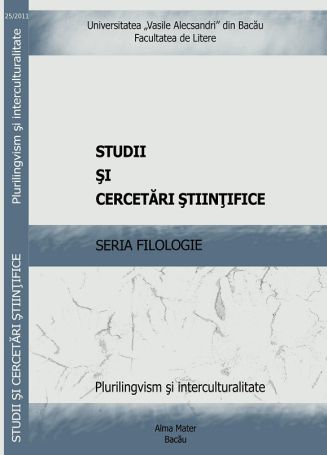
Coperta Studii și cercetări știinţifice. Seria filologie

Studii și cercetări știinţifice. Seria filologie

Print ISSN: 2559 - 3455

ISSN-L: 1224 - 841X

See all published issues

About

Studii şi cercetări ştiinţifice. Seria filologie (SCS)  (ISSN 2559 – 3455, ISSN-L 1224-841X) of  University „Vasile Alecsandri” from Bacau is a scholarly periodical (printed and electronic) indexed in the following dabases: ERIH+, CEEOL, Index Copernicus, Scipio,  Linguist list, Fabula, WorldCat, Britischer Verbundkatalog – COPAC, KVK.

It is also classified by CNCS 2020, in category B, in the field of Philology, #54: pdf

Studii şi cercetări ştiinţifice. Seria filologie (Scientific Studies and Research. Philological Series) invites you to partake in an exchange of ideas on plurilingualism and interculturality, a theme widely approached nowadays by specialists in anthropology, sociology, political theory, marketing and  human resources. It relates to language, literature, folklore, linguistics,  literary theory, literature-history and criticism, dramatic arts, anthropology etc.

It has become common knowledge that the recent perception of the culture goes beyond – or rather integrates at a higher level – the heritage of the bookish culture. Perceived as it is, culture ignores neither its social nor its pragmatic dimension; with this new acception, it equally involves an ensemble of practices, representations and habits that – just due to his belonging to a collectivity – is placed at the individual’s disposal and helps define his identity.

Above the intellectual models of the moment, the universal cultural patrimony is – in its broadest sense – an intercultural product. It comprises the rich synthesis of elements loaned and inherited from a large variety of ethnic groups, of spiritual traditions and social practices which, in the course of time, have met, competed with each other and interacted.

Specific topics of the journal

  • linguistic representation and collective mentality;
  • literary imaginary and ideology;
  • translation, comparativism and interculturality;
  • Romanian culture and literature within the European context;
  • ethno-anthropological premises of interculturality;
  • representation, imagology, intercultural communication;
  • Otherness: contemporary myths;
  • verbal and nonverbal: representational codes and intercultural dialogue;
  • natural language and the new (multi)media technologies.

The theoretical framework is provided by comparative and intercultural studies, comparative literature, cultural anthropology – ethnology, folklore, ethnolinguistics, anthropology of literature and theatre, anthropology of communication –, literary history and critical studies, sciences of language and communication. It still could be enlarged, from an interdisciplinary approach, as long as it complies with the general theme of the journal and the special topics of each thematic issue.

Languages of publication are Romanian, English or French.

Editorial board

Redactor-șef: Vasile Spiridon

Comitet editorial: Nicoleta Popa Blanariu, Luminiţa Drugă, Florinela Floria, Adrian Jicu, Violeta Popa, Petronela Savin

Comitetul știinţific

  • Simona Bealcovschi, Université de Montréal, Canada
  • Florica Bodiștean, Universitatea „Aurel Vlaicu” din Arad, România
  • Mihaela Cernăuţi-Gorodeţchi, Universitatea „Alexandru Ioan Cuza” Iași, România
  • Tatiana Ciocoi, Universitatea de Stat din Moldova, Chișinău, Republica Moldova
  • Daniel Cristea-Enache, Universitatea București, România
  • Ioan Dănilă, Universitatea „Vasile Alecsandri” din Bacău, România
  • Mircea A. Diaconu, Universitatea „Ștefan cel Mare” Suceava, România
  • Liviu Dospinescu, Université Laval, Québec, Canada
  • Stelian Dumistrăcel, Institutul de Filologie „A. Philippide” Iași, Filiala Academiei Române
  • Cristina Florescu, Institutul de Filologie „A. Philippide” Iași, Filiala Academiei Române
  • Alexandru Gafton, Universitatea „Alexandru Ioan Cuza” Iași, România
  • Gabriela Haja, Institutul de Filologie „A. Philippide” Iași, Filiala Academiei Române
  • Luminiţa Hoarţă-Cărăușu, Universitatea „Alexandru Ioan Cuza” Iași, România
  • Till R. Kuhnle, Université de Limoges, Franţa
  • Asun López-Varela, Universitatea Complutense Madrid, Spania
  • Marius Miheț, Universitatea „Comenius”, Bratislava, Slovacia; Universitatea din Oradea, România
  • Doris Mironescu, Universitatea „Alexandru Ioan Cuza” Iași, România
  • Antonio Patraș, Universitatea „Alexandru Ioan Cuza” Iași, România
  • Lăcrămioara Petrescu, Universitatea „Alexandru Ioan Cuza” Iași, România
  • Ștefana Pop-Curșeu, Universitatea „Babeș-Bolyai”, Cluj-Napoca, România
  • Ioan Pop-Curșeu, Universitatea „Babeș-Bolyai”, Cluj-Napoca, România
  • Constantin Schifirneţ, Școala Naţională de Studii Politice și Administrative, București, România
  • Eugen Simion, Academia Română
  • Geoffrey Sykes, University of New South Wales, “Southern Semiotic Review”, Australia
  • Răzvan Voncu, Universitatea din Bucureşti, România

Coperta: Anca Mihăilă
Adresa redacţiei:

Universitatea „Vasile Alecsandri” din Bacău
Facultatea de Litere, str. Spiru Haret, nr. 8, Bacău, România, Tel. / fax: 0234 – 588884, e-mail: studiisicercetari3@yahoo.com

Instructions for Authors

Guidelines for the preparation of studies and articles for publication in Studii şi cercetări ştiinţifice. Seria filologie (Scientific Studies and Research. Philological Series)

When preparing texts proposed for publication, please observe the following recommendations:

  • The paper must be written in Microsoft Word, in one of the following languages: Romanian, English, French, or German;
  • B5 format;
  • Margins: 3 cm left, 2 cm right, 2 cm top and bottom;
  • Font: Times New Roman, size 11, single spacing, justified.

The first page must contain:

  • the author’s/ authors’ first and last name, Times New Roman 11, at the top of the page, without a blank line, right-aligned, bold;
  • the university / institutional affiliation, one line below the author’s name (Times New Roman 11, regular, no bold or italics);
  • three lines below, centered, the title of the paper in capital letters (Times New Roman 11, bold);
  • two lines below, the title of the paper translated into English (Times New Roman 11, italics), followed by the abstract in English (Times New Roman 11) and the keywords / key phrases (5–10) (Times New Roman 11, italics).

After one blank line, the body of the article will be inserted.

The bibliography will be placed one line after the article and preceded by the heading BIBLIOGRAPHY (Times New Roman 11, bold, capital letters).

Authors will be listed in alphabetical order, with full bibliographic details allowing identification of the publication. For online sources, the website address must be indicated.

Examples:

  • Bloom, Harold, Omens of Millenium. The Gnosis of Angels, Dreams, and Resurrection, New York, Riverhead Books, 1996.
  • Kleiber, George, “Contexte, interprétation et mémoire: approche standard vs approche cognitive”, in Langue française, no. 103, Paris, Larousse, 1994.
  • Sedlmayr, Hans, Pierderea măsurii. Arta plastică a secolelor XIX şi XX, ca simptom şi simbol al vremurilor, Romanian translation by Amelia Pavel, Bucharest, Editura „Meridiane”, 2001.

Quotations must be enclosed in quotation marks and should not be italicized. Quotations longer than three lines must be inserted into the text with a two-tab indentation, leaving one blank line before and after the quoted passage.

Footnotes will be used for references, each note ending with a period.

Examples:

  • Louis Kelly, The True Interpreter: A History of Translation Theory and Practice in the West, New York, St. Martin’s Press, 1979, p. 34.
  • Lucian Blaga, “Daimonion”, in Opere VII: Eseuri, edited by Dorli Blaga, Bucharest, Editura Minerva, 1980, pp. 285–354.

If a work has been cited previously but the reference is distant, indicate the author’s name and the first word of the title, followed by ellipses.

Example:

  • Saint Augustine, De doctrina…, op. cit., p. 59.

If reference is made to the same source on the same page:

  • Ibidem, p. 60.

Pages must not be numbered.

Reviewing procedure

The SCS peer reviews all the material it receives. The articles are scanned for plagiarism using „Plagiarism Detector Pro” and then, they are evaluated by qualified members of academic field (University professors, members of the scientific committee chosen depending on their expertise in their own field of activity) and the evaluation (peer review) is sent 4-6 months after submission in a composite evaluation from the comments by 2 or 3 readers.

The final decision will be made by the editorial board, taking into account the recommendations of the members of the scientific committee and of the other scholars invited to peer-review, depending on their expertise in their own field of activity.

Also, publication follows maximum one year after the actual submission, usually in the next issue.

Evaluation Criteria

Thematic areas and corpus of study (25%)

  • Is the thematic area of present interest? Does it highlight a new perspective upon the studied phenomenon? Does it draw attention upon less known phenomena?
  • Does the paper meet the requirements of the thematic issue?
  • Is the corpus of study properly demarcated (both qualitative and quantitative)?
  • Does the paper properly pertain to status of knowledge of the domains in which it integrates?

Methodology, points of view (25%)

  • Are the concepts and the other theoretical instruments correctly chosen and used?
  • Are the key words properly selected and used in the paper?
  • Are the previous theories correctly linked to the topic of the paper?
  • Is the paper theoretically and methodologically coherent?

Implications and applications (25%)

  • Does the paper bring an original contribution to the theoretical development of its field/fields of interest?
  • Is it suitable to further investigation or for practical purpose?

The quality of writing (25%)

Recommendations:

  • The paper is to be accepted (without any adjustments or minor changes): 75-100%
  • The paper must accept major alterations before publishing : 60-75%
  • The paper cannot be published : under 60%

Open access policy

SCS is a delayed access journal, which provides free online access upon the expiry of an embargo period following the initial publication date (with the embargo length varying from 5 to 12 months)

Publication ethics

(in compliance with Elsevier recommendation)

The publication of an article in the peer-reviewed journal Studii si cercetari stiintifice. Seria filologie (SCS) is a direct reflection of the quality of the work of the authors and the institutions that support them. The policy of the journal demands ethical behaviour from all parties involved in the act of publishing: the editors, the authors, the reviewers and others involved in publishing process and dissemination outcomes of the research.

1. Duties of Editors
Publication decisions
The editorial team of Studii si cercetari stiintifice. Seria filologie (SCS) is responsible for the selection of the papers published in the journal. The editors will be guided by the policies of the journal’s editorial board, including the copyright infringement and plagiarism. Each member of the editorial team will confer with other editors and reviewers in making the publication decision.

Fair play
The editors will evaluate manuscripts for their scientific content without regard to race, gender, sexual orientation, religious belief, ethnic origin, citizenship, or political philosophy of the authors.

Confidentiality
The editors must not disclose any information about a submitted manuscript to anyone other than the corresponding author, reviewers and the publisher.

Disclosure and conflicts of interest
Unpublished materials must not be used in an editor’s own research without the consent of the author.

Involvement and cooperation in investigations
The editors should take responsive measures when ethical complaints have been presented concerning a submitted manuscript or a published paper.

2. Duties of Reviewers
Contribution to Editorial Decisions
Peer review assists the editors in making editorial decisions and may also assist the authors in improving their papers.

Promptness
Any reviewer who feels unqualified to review the research reported in a manuscript should notify the editors and excuse him/herself from the review process.

Confidentiality
Any manuscripts must not be shown to or discussed with others except as authorized by the editor.

Standards of Objectivity
Reviewers should express their views objectively with supporting arguments.

Acknowledgement of Sources
Reviewers should identify relevant published work that has not been cited by the authors. Reviewers should also call to the editors’ attention any overlap between the manuscript under consideration and any other published paper.

Disclosure and Conflict of Interest
Informations obtained through peer review will be confidential and not used for personal advantage. Reviewers should not consider manuscripts in which they have conflicts of interest resulting from competitive, collaborative, or other relationships.

3. Duties of Authors
Reporting standards
Authors of papers should present an accurate account of their work and an objective discussion of its significance. Underlying data should be represented accurately in the paper. A paper should contain sufficient detail and references to permit others to replicate the work. Fraudulent or knowingly inaccurate statements constitute unethical behavior.

Data Access and Retention
Authors are asked to provide the raw data in connection with a paper for editorial review, and should be prepared to provide public access to such data and should in any event be prepared to retain such data for a reasonable time after publication.

Originality and Plagiarism
Authors should ensure that submitted work is original and has not been published elsewhere, and if the authors have used the work of others that this has been cited or quoted.

Applicable copyright laws and conventions should be followed. Copyright material (e.g. tables, figures or extensive quotations) should be reproduced only with permission and acknowledgement.

Multiple, Redundant or Concurrent Publication
Submitting the same manuscript to more than one journal concurrently constitutes unethical publishing behavior and is unacceptable. The editors may agree to the secondary publication, when it reflects the same data and interpretation of the primary document. The primary reference must be cited in the secondary publication.

Acknowledgement of Sources
Proper acknowledgment of the work of others must always be given. Authors should cite publications that have been influential in their work.

Authorship of the Paper
Authorship should be limited to those who have made a significant contribution to the research. All those who have made significant contributions should be mentioned as co-authors. Where there are others who have participated in the research project, they should be acknowledged or listed as contributors.

The corresponding author should ensure that all appropriate co-authors and no inappropriate co-authors are included on the paper, and that all co-authors have seen and approved the final version of the paper and have agreed to its submission for publication.

Hazards and Human or Animal Subjects
If the work involves chemicals, procedures or equipment that have any unusual hazards inherent in their use, the author must clearly identify these in the manuscript.

Disclosure and Conflicts of Interest
All authors should disclose in their manuscript any financial or other substantive conflict of interest that might be construed to influence the results or interpretation of their manuscript. All sources of financial support for the project should be disclosed.

Fundamental errors in published works
When an author discovers a significant error or inaccuracy in his/her own published work, it is the author’s obligation to promptly notify the journal editor or publisher and cooperate with the editor to retract or correct the papers.

The journal allows the author(s) to hold the copyright without restrictions and author(s) are allowed to retain publishing rights without restrictions.

Contact

Facultatea de Litere, Universitatea „Vasile Alecsandri” din Bacău
str. Spiru Haret, nr. 8, Bacău, România

Tel./ fax: 0234 – 588884, e-mail: studiisicercetari3@yahoo.com

Editura "Alma Mater" – "VASILE ALECSANDRI" UNIVERSITY OF BACAU

editura-almamater.ub.ro , edituraalmamater@gmail.com